A working guide to Hillsong Reserve, our private collection of twelve coffee-estate
villas in Sakleshpur — how the ownership model works, what the four-leg return
structure actually means, and why the Western Ghats sit where they sit on the map of
Indian luxury hospitality.
The Property
What is Hillsong Reserve?
Twelve private estate villas inside a working 20-acre coffee estate in the
Sakleshpur hills. Sold individually. Held freehold. Managed centrally.
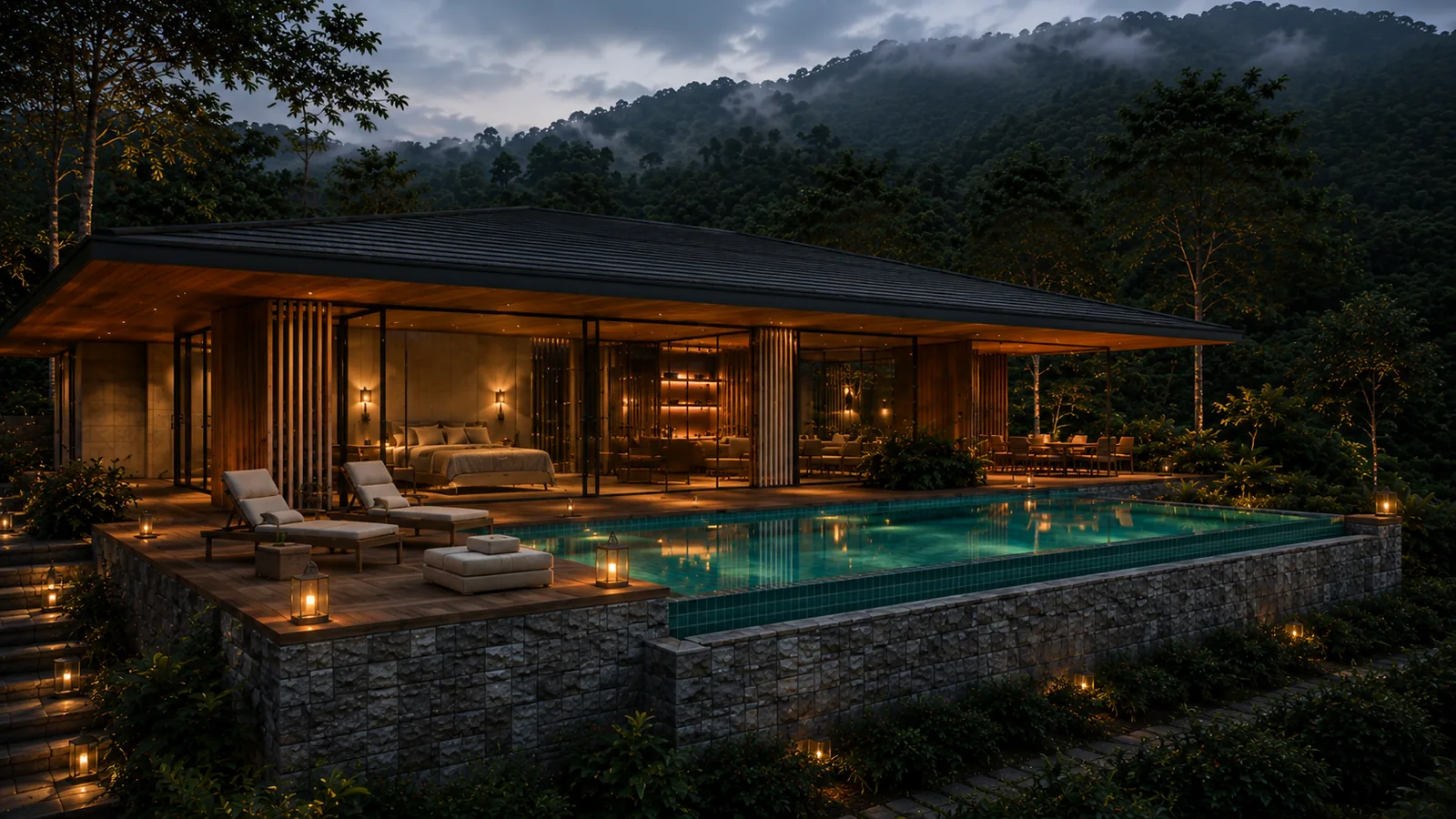
A Hillsong Reserve villa at dusk — the estate's signature evening light.
Hillsong Reserve is a limited-collection villa development inside a functioning
coffee estate in Sakleshpur, in the Western Ghats. The collection consists of
twelve villas in total: eight Estate Villas of one bedroom and four
Signature Villas of two bedrooms. The estate spans roughly 20 acres of
coffee and forest cover.
Each villa is sold as a freehold asset. The buyer's name is on the sale deed. The
title is recorded with the sub-registrar's office. Nothing about the underlying
ownership is unusual; it is a private freehold purchase, registered the way any
villa or apartment in Karnataka is registered.
What's different is the structure around the property. Hillsong Reserve is designed
to be lived in, hosted from, and held — but also professionally managed when the
owner is away. Amyra Farms runs the estate, the rental pool, the hospitality
services, and the maintenance. Owners reserve their personal nights, the rest of
the calendar is rented to vetted guests, and the revenue is shared.
The product was conceived for a specific buyer: someone who wants the experience of
owning a private villa in the hills, the cash returns of boutique-luxury
hospitality, and the appreciation of plantation-grade land — without taking on the
operational complexity that usually comes with all three.
The Category
Coffee estate villas — a new category in Indian luxury real estate
Holiday homes are old. Branded resorts are old. The thing that's actually new is
the third path — owning a private villa inside someone else's managed brand.
The Indian luxury second-home market has historically offered two products. The
first is the holiday home — you buy a villa or bungalow in a hill
station or beach town, hold the keys, and use it (or don't) when life permits. The
second is the branded condotel — a hotel-style asset where you buy
a room or suite that is permanently managed by the operator, with limited or no
personal-use rights.
What both options miss is the in-between. Many serious buyers want all three things:
full freehold ownership, meaningful personal use, and a working rental
yield. They want their property to feel like theirs — bookable for a long
weekend with friends, an anniversary, or a quiet writing month — but they don't
want it sitting idle three hundred days a year either.
The "branded private villa" structure that has matured globally — in Bali, Costa
Rica, parts of Portugal — solves exactly this. The owner holds the freehold title.
The operator runs a hospitality brand that wraps the property. Owners reserve their
nights, the property earns the rest of the year. Hillsong Reserve is the Indian
version of that structure, sized for twelve villas and one estate.
It is not a copy. The Indian context — the legal framework, the buyer profile, the
regulatory environment, the labour economics, the climate — meant the product had
to be built locally. But the underlying idea, that an owner can have a real home
and a real return on the same asset, is now well-tested elsewhere. Our job
was to make it work here.
The Model
The Hillsong Reserve ownership model — what you own, what we manage
The split is simple. You own the asset. We run the operation. The numbers in
between are clearly defined.
What the owner owns is the villa itself, fully and outright. A
registered sale deed in the owner's name. A freehold title with no time-share
component, no fractional structure, and no rotating ownership.
What Amyra Farms manages is the operational layer around the
villa. That includes day-to-day estate upkeep (landscaping, infrastructure, paths
and lighting, common-area amenities), villa-level housekeeping and maintenance to a
hospitality-grade standard, the guest experience when the villa is rented, food-
and-beverage and experiences hosted from the estate (coffee tastings, dining, walks,
spa), and brand-and-marketing — the work of keeping Hillsong Reserve visible to the
right buyers and guests.
The economics
When the villa is in the rental pool, room revenue is split between the owner and
the operator. The owner share is 55% — paid out quarterly with
transparent line-item statements. The operator share covers staffing, marketing,
hospitality services, brand investment, and the operational guarantee that makes a
hospitality property actually hospitable.
The owner reserves personal-use nights — twenty per year, including up to
seven peak nights — booked transparently on a six-month forward calendar.
There is no use-it-or-lose-it constraint; an unused night is simply added back to
the rental pool that quarter.
The maintenance line is the only fixed cost the owner pays directly. It is
structured per-month, escalates with inflation, and covers everything from
utilities to ongoing structural upkeep. Beyond that, the owner's relationship with
the operating economics is a simple revenue share.
Returns
How a villa earns four ways
Rental income, personal-use value, capital appreciation, and brand equity. The four
legs work independently — and they don't all depend on the same factors going right.
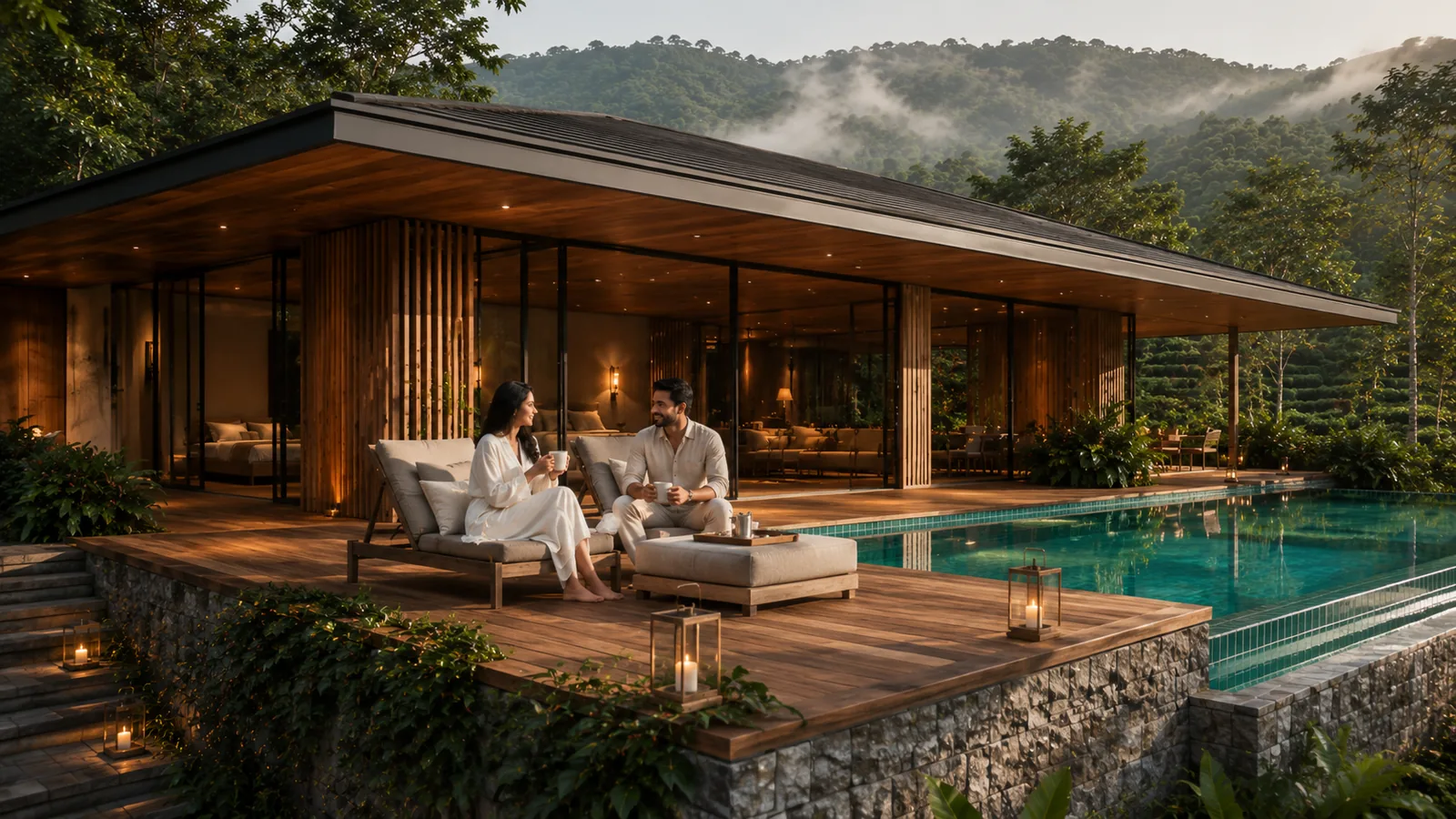
An owner stay — the personal-use leg of the return model.
The first leg is rental income. When the villa is in the managed
pool, it earns. We project occupancy ramping from 35% in Year 1 to 65–68% by Year 5,
in line with how comparable boutique-luxury properties in Coorg and Wayanad
stabilise. Average daily rates start at ₹18,000–₹32,000 for the two villa types and
grow into the ₹30,000–₹52,000 range as the brand matures.
The second leg is personal-use value. Twenty nights a year, valued
at the prevailing ADR for the year, compounds over a decade into a quietly material
number — ₹56.8 lakh for an Estate Villa, ₹98.9 lakh for a Signature Villa, in our
base case. Critically, this is real economic value: rent foregone is the same as
rent earned, from the owner's perspective.
The third leg is capital appreciation. We model this at 7% per
annum, compounded on launch price. This is conservative against the
boutique-hospitality-property benchmark in the Western Ghats, which has historically
run 8–12% p.a. Even at 7%, the Estate Villa's launch price of ₹2.85 Cr grows to
₹5.61 Cr over the decade — a capital gain of ₹2.76 Cr.
55%
Owner share of pool revenue
20 nts
Personal-use entitlement / year
7% p.a.
Conservative appreciation model
The fourth leg is brand equity. This one is hard to put a number
against, and we don't try. Owning into a registered, brand-positioned property,
with patents filed, with a working farm underneath, on an estate that's becoming a
destination — that has long-arc value that operates outside the immediate cash
flows. We mention it because the buyers who get the model already know this; we
leave it to them to weight it.
Across the four legs, the total value created on a ten-year horizon — net rental +
personal-use value + capital gain — comes to roughly 220–230% of the original
outlay across both villa types. That figure is the headline. The PDF schedules show
the detail.
Villa Value · 10-Year Appreciation Curve
At 7% p.a. compounded on launch price. Conservative vs the 8–12% Ghats benchmark.
Signature Villa (2 BHK) · ₹4.75 Cr → ₹9.34 CrEstate Villa (1 BHK) · ₹2.85 Cr → ₹5.61 Cr
Capital gain only — does not include rental income or personal-use value, which
are tracked separately. The Western Ghats boutique-hospitality benchmark has
historically appreciated at 8–12% p.a.; we model at 7% to stay conservative.
For the Investor
ROI, demand, occupancy — the investor's first questions
Strip away the lifestyle pitch and these are the questions that decide whether a
villa belongs in a portfolio. Direct answers, using the figures we actually model.
2.2–2.3×
Projected total value over 10 years
65–68%
Stabilised occupancy by Year 5
₹2.85 Cr
Entry ticket · Estate Villa
"What return should I actually expect?"
Our base case projects total value created — net rental income, the value of your
twenty personal-use nights, and capital appreciation combined — at roughly
220–230% of your outlay over a ten-year hold, or about 2.2–2.3×
the capital you put in. Because that blends three independent legs, the headline
doesn't rest on any single assumption going perfectly. The year-by-year
cash-and-value schedule is laid out in the owner ROI document — we'd rather walk
you through it line by line than reduce it to a single number here.
"What does it pay while I hold it — the cash yield?"
Three levers set the cash return: occupancy, average daily rate, and your
55% share of pool revenue. Rental cash is deliberately light in
Year 1, while the brand is being introduced, and builds as occupancy ramps and ADR
matures from the ₹18,000–₹32,000 launch band toward ₹30,000–₹52,000. Maintenance is
a small line against even modest revenue, so the rental leg stays positive through
the ramp rather than turning negative. The full cash-flow schedule, year by year and
net of costs, sits in the owner ROI document.
"Is there real demand for luxury stays in Sakleshpur?"
The demand case rests on four things we can point to rather than assert. First,
catchment: Sakleshpur is ~220 km — a four-hour drive — from Bengaluru, a metro of
over 13 million and one of the largest sources of high-spend domestic leisure travel
in South India. Second, the regional benchmark: well-run boutique-luxury properties
across the Coorg–Wayanad–Sakleshpur belt command ₹40,000–₹55,000 a night and
stabilise at 60–70% occupancy, with average length of stay rising past three nights.
Third, scarcity: there are twelve villas in total — no phase 2, no dilution of the
inventory. Fourth, the structural shift toward nature-led, owned-feeling stays over
corporate hotels, which has outgrown the broader hospitality market for a decade.
None of these is a guarantee on its own; together they are why we built here rather
than waited.
"What occupancy are you assuming — and is it realistic?"
We model occupancy ramping from 35% in Year 1 to about 58% by Year 3 and
65–68% by Year 5, then holding. That sits at or below where comparable
Western Ghats properties stabilise (60–70%), which is deliberate — a new brand
should underwrite its own ramp conservatively. If occupancy lands short, the rental
leg simply pays less; it does not turn negative, and the personal-use and
appreciation legs keep working independently of it.
"What's the entry ticket, and how do I get out?"
Estate Villas (1 BHK) start at ₹2.85 Cr; Signature Villas (2 BHK)
at ₹4.75 Cr — freehold, registered in your name, sold with the management structure
already in place. There is no lock-in: you can sell at any time, we hold a right of
first refusal to protect brand continuity, and plantation-region villa resales
typically close in 30–90 days, with our help to facilitate. The harder version of
these questions — what if it doesn't rent, what if the operator changes — is
answered in full further down this guide.
The Location
Why the Western Ghats?
It is 220 kilometres from Bengaluru, sits at 950 metres of elevation, is wrapped in
mist for half the year, and has a 150-year history of premium coffee. That's the
short answer. The long answer is in the climate, the road, and the company.
Sakleshpur sits in Hassan district, on the western edge of Karnataka, where the
Deccan Plateau drops into the Western Ghats range. The elevation profile climbs
from roughly 850 to 1,200 metres above sea level. Annual rainfall averages
3,500–4,000 mm, concentrated in the southwest monsoon between June and September.
Average temperatures stay in the 18–28 °C band year-round — cool enough that the
climate is genuinely a respite from Bengaluru's heat, mild enough that the property
is comfortable to occupy in any month.
From Bengaluru, the drive takes about 4–4.5 hours via the Bengaluru-Mangaluru
highway (NH-75). The road is now substantially four-laned. The trip is comfortable
enough to be a weekend habit rather than an annual occasion. Mangaluru airport is
two hours west; Kannur airport is roughly three. For a Bengaluru-based owner, the
drive is the right mode; for visitors from further afield, flying into the coast
and driving up is a workable alternative.
The cultural and economic context matters too. Sakleshpur and the adjacent
Chikmagalur belt have hosted estate families for five generations. The villages
around the estate run on coffee. The neighbours are growers, not speculators. The
infrastructure — water, power, road, communications — is decent and improving rather
than fragile. And the regional destination map is interesting: Coorg, Halebidu,
Belur, and the route to the western coast all sit within a one-to-two-hour radius,
which gives owners and guests reasons to combine a visit with longer regional
travel.
For a buyer comparing locations, the alternatives — Coorg proper, Wayanad, Munnar,
Mahabaleshwar — all have merits. What Sakleshpur uniquely combines is proximity to
a major Indian metro, a deep coffee-estate heritage, and pricing that has not yet
hit the saturation point of Coorg.
Where the Reserve sits
220 km from Bengaluru. 4 hours by road. Inside the Ghats coffee belt.
Stylised for clarity, not to geographic scale. The estate sits inside the Western
Ghats range, on the cooler windward side of the plateau drop.
Choosing Your Villa
Estate Villa (1 BHK) vs Signature Villa (2 BHK)
Two villa types. Similar arithmetic. Different lifestyle.
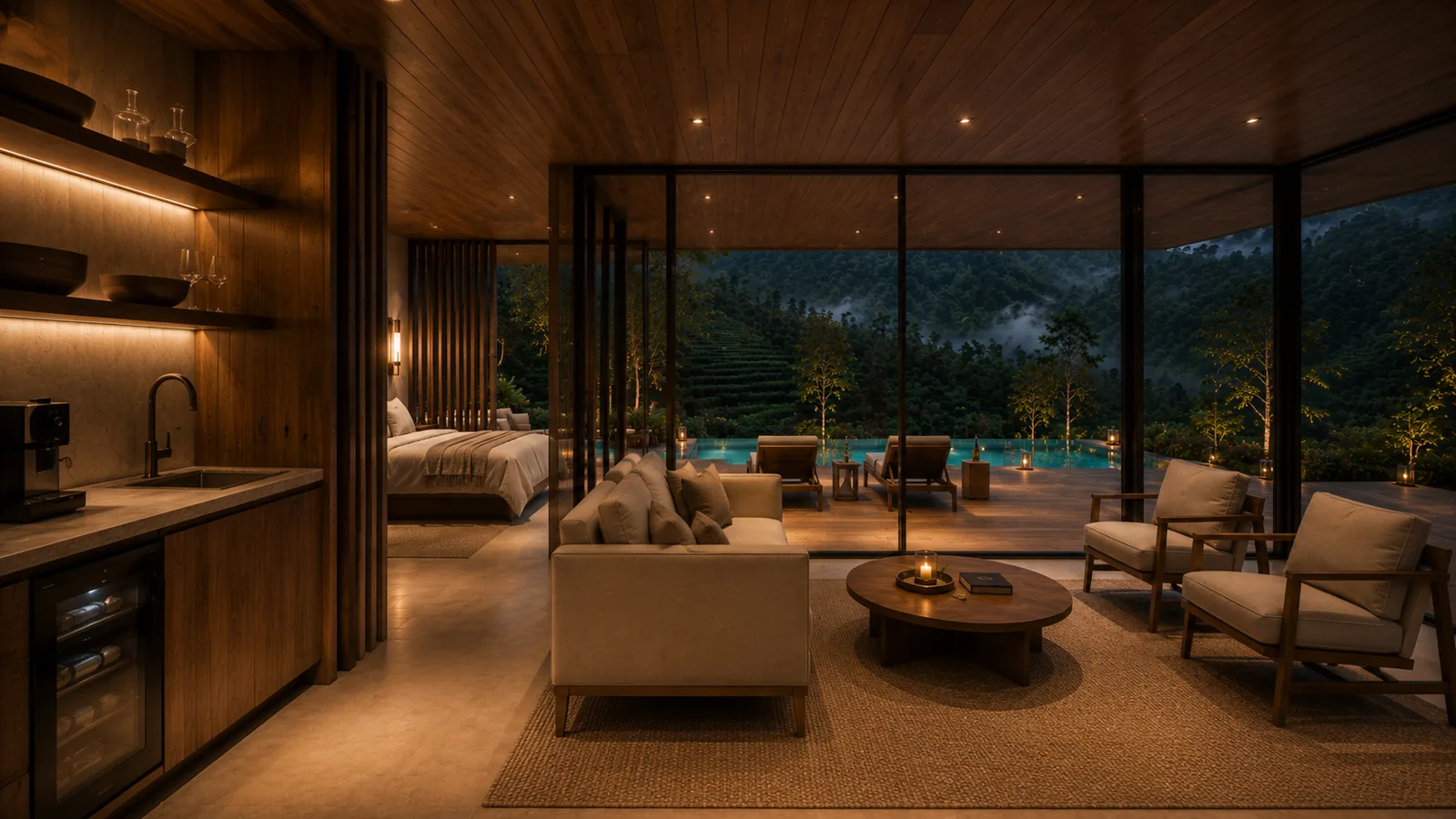
The interior lounge — floor-to-ceiling glass, oiled-wood ceiling, valley views.
The Estate Villa is the smaller of the two formats — one bedroom,
roughly 1,100 square feet of indoor area, designed for a couple or a single
occupant who wants a private retreat without the scale of a family home. There are
eight Estate Villas in the collection, which makes them the more available product
and the more accessible entry point at ₹2.85 Cr.
The Signature Villa is twice the size and roughly 70% more
expensive at ₹4.75 Cr. Two bedrooms, about 2,000 square feet of indoor space,
designed for a family of four to six or for a buyer who wants to host. Only four
Signature Villas exist, which makes them the rarer product and the more obvious
choice for a buyer who values exclusivity within an already-limited collection.
The rental economics scale proportionally. The Signature Villa commands a roughly
70% higher daily rate and produces correspondingly higher absolute returns. The
Estate Villa, because it sells at a lower entry price, delivers a comparable
stabilised yield percentage — the percentage-return math comes out within
roughly 70 basis points of the larger villa, despite the smaller scale.
Which one to choose comes down to two things. First, who's going to use
it. If the primary use case is a couple's retreat or a writer's room —
the Estate Villa is sized correctly. If the use case is family weekends, hosting
two or three friend couples, or extended multi-generational stays — the Signature
is the right format. Second, allocation sizing. The Signature is a
larger cheque, which suits buyers who want a single decisive position rather than
a smaller starter.
Across both formats, the ownership rights, the management structure, the
personal-use entitlement (20 nights/year), and the appreciation framework are
identical.
The Market
The boutique-luxury hospitality market case
Indian boutique-luxury hospitality has quietly become one of the more interesting
subsectors in the country's tourism economy. Hillsong Reserve sits inside it.
The premium leisure-travel market in India has matured along two parallel tracks.
The first is the international branded hotel — large-format, urban or near-urban,
optimised for business travel and conferences. The second, and the one that has
grown faster over the last decade, is the boutique-luxury independent property —
small-format, high-touch, located in specific destinations chosen for landscape,
culture, or wellness.
The numbers behind the second category are striking. Boutique-luxury room rates in
the Coorg–Wayanad–Sakleshpur belt range from roughly ₹40,000 to ₹55,000 per night
at the top end. Stabilised occupancy at well-run properties sits in the 60–70%
band; the very best operators run higher. Average length of stay has been creeping
up — three nights is the new two.
The buyer of these stays is consistent: domestic, primarily metro-based, willing to
pay for atmosphere and service rather than brand familiarity, and increasingly
looking for something that feels owned rather than corporate. Hillsong Reserve sits
inside this demand.
Our ADR ramp assumes ₹18,000–₹52,000 across the two villa types over the ramp
years. We are conservatively positioned versus the regional benchmark, on purpose:
the brand needs time to establish, and we'd rather under-promise on ADR and beat it
than over-promise and disappoint.
The macro tailwinds — rising disposable income, post-pandemic preference for
nature-led stays over crowded urban breaks, and the steady professionalisation of
Indian hospitality operating standards — are real. None of them is guaranteed to
continue at the current rate. But the directional argument is strong enough that we
built around it.
For NRIs
Can NRIs buy a Hillsong Reserve villa?
Yes — with one important distinction from the farmland question. Hillsong Reserve
villas are residential properties on land that is registered for built-up
construction, which puts them in a different regulatory bucket from raw
agricultural acres.
The general FEMA framework for NRIs and Persons of Indian Origin
permits the purchase of residential and commercial property in India.
It restricts the purchase of agricultural land, farmhouse land, and plantation
property. Hillsong Reserve villas are built and registered on residential-use
approved land within the estate; the villa itself is a residential structure with a
registered sale deed.
In plain terms: an NRI, OCI, or PIO buyer is permitted to purchase a Hillsong
Reserve villa on the same basis as any other Indian residential property. The
transaction can be funded through NRE/NRO accounts or remitted from abroad through
banking channels. Rental income on the villa is taxable in India and may be
remitted abroad up to permissible limits.
A few practical notes
The transaction documentation should be reviewed by an advisor familiar with NRI residential property purchases — most chartered accountants who work with NRIs handle this routinely.
The TDS framework on rental income payable to NRI lessors has specific provisions worth understanding upfront.
If the villa is later sold, capital gains tax rules for NRI sellers apply in their familiar form.
We are happy to make introductions to legal and tax professionals who have completed
comparable transactions, including with international buyers from the UAE, Singapore,
the UK, and the US. The intent is to make the path frictionless rather than
mysterious.
The Operator
About Amyra Farms — and why we built Hillsong Reserve
Hillsong Reserve isn't a real-estate project that happens to be on a farm. It's a
hospitality brand built on top of an estate we already operate. Here's who runs it.
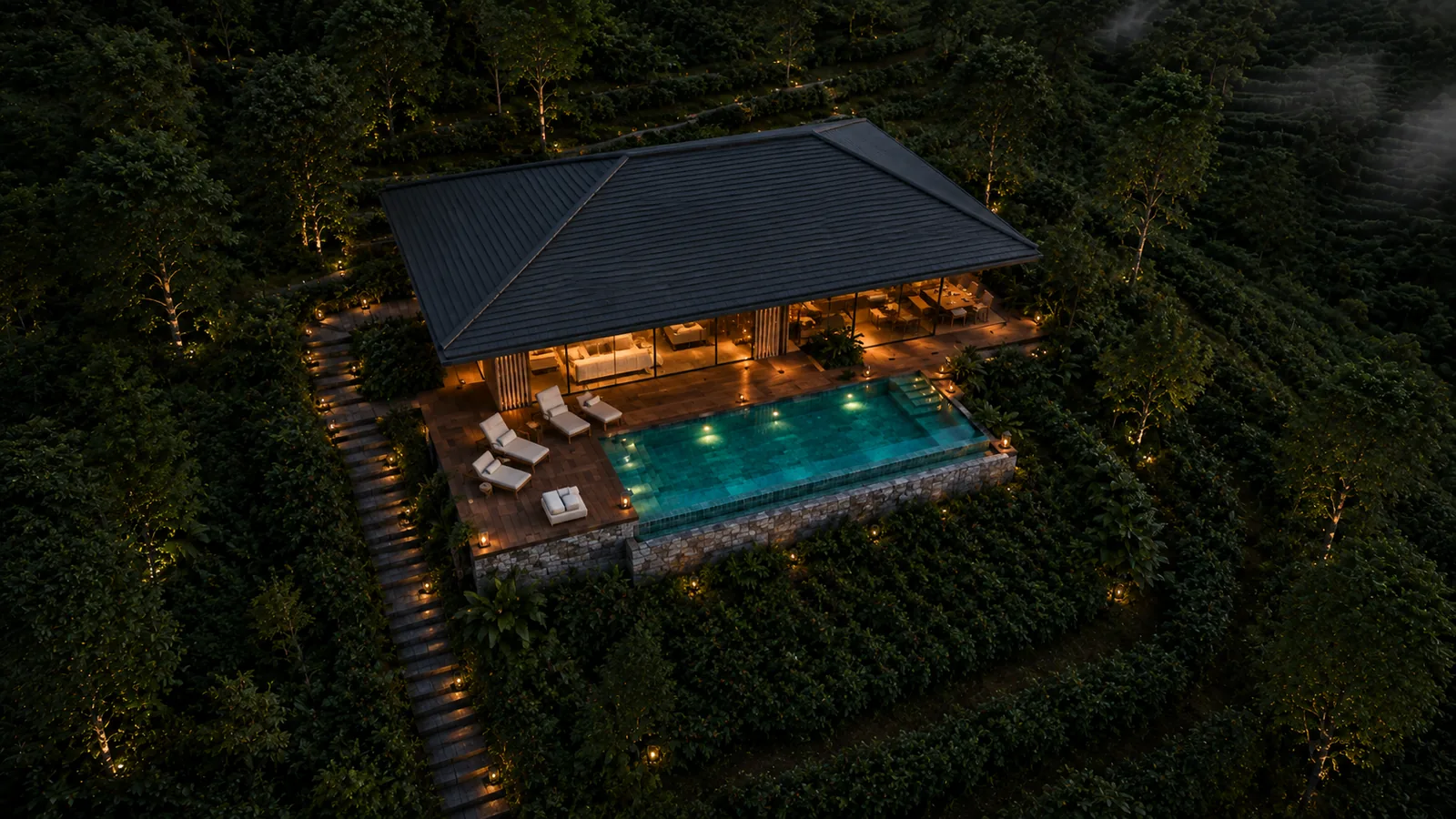
Hillsong Reserve from above — twelve villas inside a 20-acre working estate.
Amyra Farms is the operating brand behind Hillsong Reserve. We have been in the
Sakleshpur–Chikmagalur belt for several years, operating a working coffee estate of
roughly 450 acres across the region. The Hillsong Reserve villas sit on a 20-acre
portion of that footprint, designed and built from the ground up as a premium
private-residence collection.
The team behind Hillsong Reserve includes a plantation operations leadership that
has been on this land for a generation, a hospitality leadership recruited from
boutique-luxury properties elsewhere in India and abroad, and a design team that
worked with us through three rounds of villa schematics before we settled on the
current product.
We deliberately built the brand with the working farm underneath. The villa owner
is not buying into a manicured resort that pretends to be in nature; they are
buying into a working coffee estate where the morning starts with bean-picking in
the south block and the afternoon ends with a coffee tasting on the deck. The
estate is the experience.
One more thing worth knowing about the operating company. Amyra Farms is
the only brand in the Indian managed-plantation category that has built a fully
vertical company structure — estate, processing, brand, distribution, and
retail all sit inside one operating business. Our coffee ships through 100+
distributors across India and into 50+ international markets. That structure is
unusual; the next article explains why it matters.
A note on scale. There are exactly 12 Hillsong Reserve villas. We
will not sell a thirteenth. The product is sized for the estate's carrying capacity
— the number of villas that can be hosted with the level of service we are
committing to — not for our revenue target. If a buyer wants to be one of many in a
large branded development, there are well-built options at that scale. What we are
offering is the opposite.
The Parent Business
The business behind the brand — vertical integration + the 20-year roadmap
Buying a Hillsong Reserve villa is also a bet on the operating company. Here's why
the Amyra Farms business behind the villas is sturdier than a typical real-estate
developer's — and what we're building over the next twenty years.
Most boutique-villa developments are built by real-estate developers. The developer
sells the units, takes the upfront, and either hands operations to a third-party
hospitality manager or builds a one-off operating team that has no business outside
this single asset. If demand softens, the operating team gets cut. If a better
project comes along, the developer's attention moves with it.
Hillsong Reserve sits on top of a different kind of company. Amyra Farms is, first
and foremost, a working agricultural operating business — and that business is
structurally unusual.
Vertical integration · estate to retail shelf
No other brand in the Indian managed-plantation category has built the
company structure we have built. Amyra Farms is the only operator that
owns every link in the chain — estate, processing, branding, distribution, and
retail. We grow the coffee, we process it in our own facility, we package it
under our own labels, and we sell it through 100+ distributors across
India and into 50+ international markets. Our products
are on Amazon and on our own DTC website today.
Because we own the whole chain, our raw-material cost is the lowest in the
category. The margin that other operators give away to wholesalers, brand owners,
and importers stays inside our business — and that margin funds the operational
standards that make a hospitality property of this calibre possible.
100+
Indian distributors
50+
Countries shipped
20,000+
Acres targeted by Y20
For a Hillsong Reserve owner, that vertical integration matters in three concrete
ways. Operating durability — the business has revenue streams that
are independent of villa rentals, which means the company stays funded even in a
soft hospitality year. Brand legitimacy — guests booking a stay
recognise the Amyra Farms name from their coffee shelf, which compounds into
occupancy. Estate authenticity — the villas sit inside a working
estate that ships its own coffee globally, not a manicured resort imitating one.
The 20-year roadmap
We are planning to expand the working estate to 20,000+ acres over the
next twenty years, concentrated in coffee and pepper. We are investing in
AI-driven agronomy and robotics for selective harvest. We are building the long-arc
operating platform that the next decade of Indian premium agriculture and
hospitality will sit on.
What that means for a villa owner is straightforward. The brand wrapped around your
villa will be substantially bigger by year ten than it is at year one. Hillsong as
a hospitality destination compounds as Amyra Farms compounds as a parent business.
Your appreciation curve is not just a function of Sakleshpur land prices — it is
also a function of the brand equity growing under the villa.
We mention this because the question every careful villa buyer asks at some point
is: "what if the operator behind this disappears in five years?" The honest answer
is that the operator behind this is a working agricultural company with cash flows
from coffee retail across India and fifty countries, a twenty-year growth plan, and
a long-arc commitment to the same belt of land. Disappearing is not in the model.
Alignment
How Hillsong Reserve actually makes money
A fair question every buyer should ask. The answer is split across three lines, and
our incentives sit on the same side as the owner's on each one.
There are three revenue streams in the Hillsong Reserve business. Understanding all
three is the cleanest way to see whether our incentives line up with yours.
The first is the villa sale itself. We sell the villa at launch
price, the buyer pays once, and the title transfers. We earn the development margin
on the build. After that transaction, that revenue stream is closed — there is no
ongoing sale we can re-extract.
The second is the rental revenue share. When the villa is in the
managed pool, room revenue splits 55% to the owner, 45% to the operator. Our
operating revenue is directly tied to the villa being booked, the ADR being earned,
and the guest experience being good enough that repeat and referral traffic
compounds. If we underperform on the brand or the operations, you earn less and so
do we. The incentive is aligned by design.
The third is maintenance and estate operations, which the owner
pays via the monthly maintenance line. This recovers cost — staffing, common-area
upkeep, utilities — and is not where we make a margin. It is the floor that lets us
actually deliver hospitality-grade operations.
The maintenance line exists for the same reason it exists on the farmland side of
the business: the estate operates year-round, but the rental revenue share is
settled quarterly. If we tried to fund daily operating cost out of a quarterly
settlement, we would have to compromise service standards during the lean months
to stay solvent — and the consequence would land directly in your 55%
share the following quarter as lower occupancy and weaker reviews. The maintenance
line keeps the operation properly funded so the share that does reach you
is the share the villa can actually deliver. It is operating capital, not profit.
What we deliberately did not include in the model is a backend revenue
split — no carry on appreciation, no exit fee, no time-share dilution. When the
owner sells, the capital gain belongs to the owner. When the brand grows in value,
the owner benefits via both the rental ramp and the appreciation curve.
This is buyer-aligned operating economics. We make money when the villa makes
money. That is the most honest way we know to structure a 10-to-20-year
hospitality partnership.
Tough Questions
The hard questions buyers ask before they buy
Some of these are obvious. Some are harder to ask. We get them all, often in the
second meeting. The honest answers.
"What if the villa doesn't rent well?"
Year 1 is light by definition. We project 35% occupancy in Year 1 because the
property is being introduced to the market. By Year 3 we expect 58%; by Year 5,
65%. These are conservative numbers against the regional benchmark; the actual ramp
will depend on brand-building velocity. If occupancy disappoints, the owner's cash
returns are lower than projected — they are not negative; the maintenance line is
small relative to even modest revenue. The personal-use value and the appreciation
legs continue to operate independently.
"What if I want to use the villa more than 20 nights?"
That's negotiable. The 20-night entitlement is the floor that protects the rental
pool from owner-use crowding out high-revenue nights. We can extend personal use,
but the additional nights are accounted for as use against the owner's revenue
share. In practice, most owners use 12–18 nights per year.
"Can I sell my villa in three years if my life changes?"
Yes. There is no lock-in. We offer right-of-first-refusal to keep brand continuity,
but we do not block your sale. Practically, plantation-region villa sales take
30–90 days to close, longer than urban apartments. We can help facilitate.
"Is the price going to drop after launch?"
The current launch pricing reflects the cost of build plus the operator's margin on
the initial cohort. Subsequent sales (if and when a villa changes hands) will price
at then-prevailing market, which we expect to be higher rather than lower based on
the appreciation projections. We do not have a "phase 2 at lower price" plan
because there will not be a phase 2 — twelve villas total.
"What happens if Amyra Farms goes out of business as a hospitality operator?"
The villa is yours regardless. The legal structure separates the freehold title
(you own) from the management agreement (the operator runs). Worst case, the
management agreement is terminated and you operate the villa yourself or appoint
another manager. The villa does not disappear; only the brand wrap might.
"Honestly, why is this priced the way it is?"
Two reasons. First, this is the first cohort of a brand-new product in a still-
emerging boutique-luxury location. We chose to price below the Coorg ceiling
deliberately. Second, the unit economics on twelve villas only work at our current
pricing — we cannot drop launch price without dropping build quality, and we are
not willing to drop build quality. Future inventory, if we expand to a sister
estate, will likely launch higher.
Comparison
Hillsong Reserve vs the alternatives
Honest tradeoffs against the four realistic alternatives a buyer in this price
range might consider. Each option has its own argument.
Versus buying a private holiday home in Coorg
The classic move. You buy a 3–4 BHK villa or bungalow, manage it yourself or via a
local caretaker, use it on weekends, occasionally rent through Airbnb. Pricing in
Coorg now ranges from ₹4–10 Cr for comparable inventory. The advantages: more
square footage per rupee, full personal control. The disadvantages: zero
professional rental yield (typical Airbnb occupancy in the region is 20–35% at
best), maintenance is your problem, brand and hospitality experience are absent.
The Coorg holiday home is a lifestyle asset. Hillsong Reserve is a lifestyle asset
that also earns.
Versus a branded condotel (resort residence)
Condotels at major hotel brands offer institutional management and a known brand.
You give up most personal use (typical 14–21 days/year, often non-peak only) and
pay a lower owner share (typical 40–50% to owner vs our 55%). The arithmetic on a
condotel works for a buyer who wants almost zero involvement. Hillsong Reserve
works for a buyer who wants meaningful personal use and a higher owner share.
Versus a Goa or Alibaug villa
Both are well-established luxury markets. Goa offers proximity to the airport and a
strong year-round rental demand; Alibaug is closer to Mumbai but with a more
restricted use window (monsoon downtime). Pricing in both is comparable to or
higher than Hillsong Reserve at the upper end. The case for Hillsong over either
is (a) the working-farm proposition that neither location offers, (b) the Western
Ghats microclimate which is comfortable year-round (Goa is hot half the year), and
(c) the operator-aligned economics of a small-collection branded property.
Versus listed REITs or property funds
A REIT in residential or hospitality is more liquid but offers no specific asset
ownership and no personal-use rights. The two are not direct competitors; many of
our buyers hold both. The case for Hillsong Reserve is the personal-use leg
specifically — that is the leg that cannot be replicated by a financial-vehicle
alternative.
Versus doing nothing — keeping the capital in equity
Equity has been a phenomenal asset class. We do not pretend otherwise. The case for
allocating some portion to a Hillsong Reserve villa over a comparable equity
allocation rests on two things: diversification (real-asset exposure with low
correlation to listed markets) and lifestyle utility (the asset you can stay in).
If neither of those is meaningful to the buyer, equity remains the better call.
The framing we encourage is: think about Hillsong Reserve as one slot in a
multi-asset allocation, not as a competitor to equity for the same capital. The
buyers who get the most out of it are the ones who are clear on what role it plays.
Take the next step
Want to see the villas?
Private viewings are by appointment. We host a small number of prospective owners
each month — a guided walk of the estate, the show villa, and an unhurried
conversation about whether Hillsong Reserve fits what you're looking for.